The Pac-Man Kill Screen: The Famous Level 256 Bug Explained
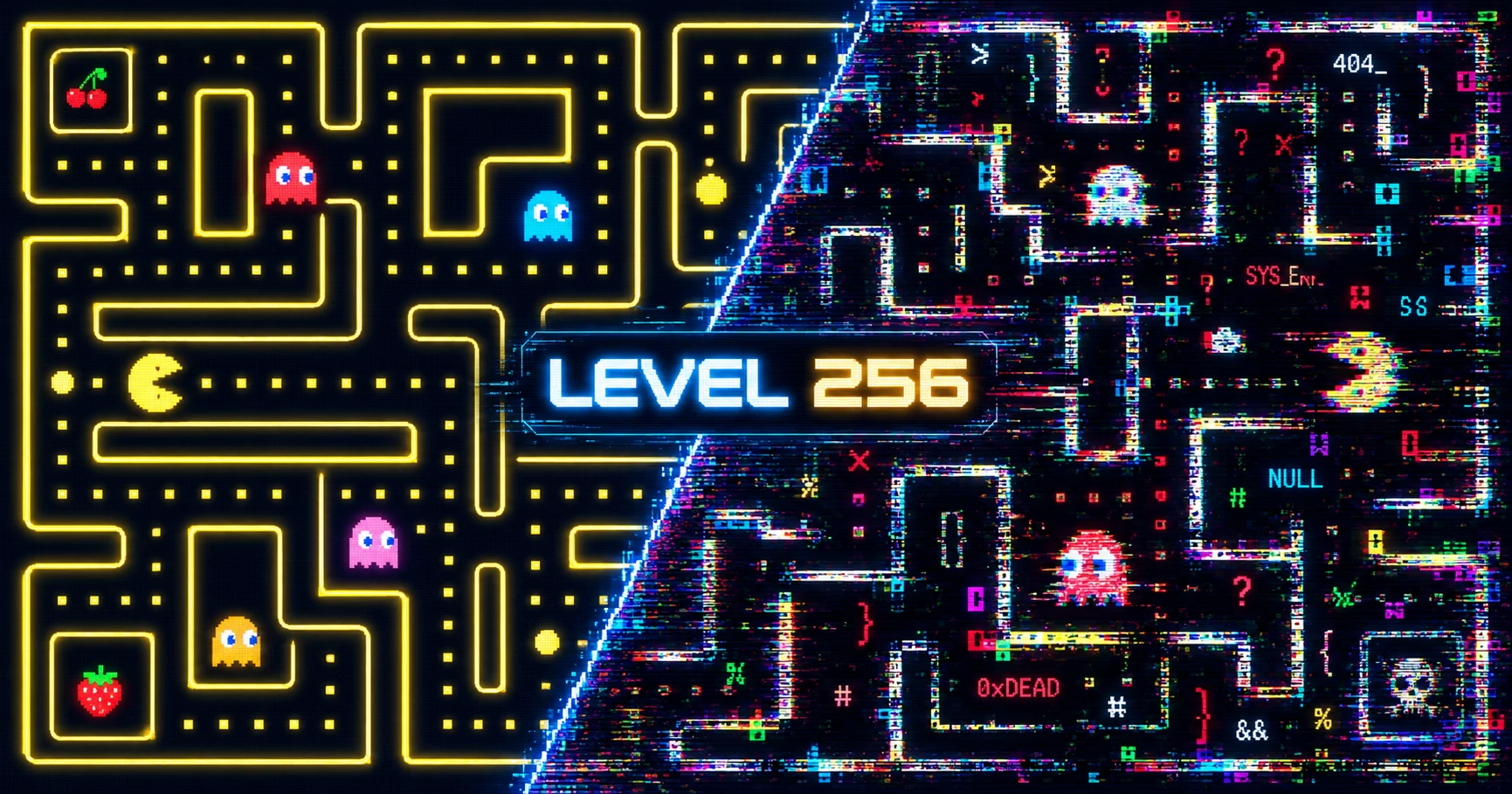
The "kill screen" is the level in the original 1980 Pac-Man where the game breaks. Half the maze turns to garbled nonsense, only half the dots exist, and the game becomes literally impossible to finish. It's one of the most-discussed bugs in gaming history — and it's caused by a single line of buggy code.
What the kill screen actually looks like
When a player reaches level 256, the game starts normally for a fraction of a second — then the right half of the screen fills with a chaotic mix of letters, numbers, symbols, and half-drawn characters. The left half of the maze remains intact and shows dots as normal. The right half shows random data being interpreted as tile graphics.
Only 112 dots are collectible on the intact left side, but the game requires 244 dots to advance to level 257. Since you can never collect enough dots, the level can't be cleared. Pac-Man dies eventually, and when your lives run out, the game ends.
Why does it happen?
The bug is caused by a single 8-bit integer overflow in the arcade code that tracks which level you're on. The game uses one byte (8 bits) to store the level number. One byte can hold values from 0 to 255.
On level 256, the level counter tries to store the value 256 in that byte. But 256 in binary is 100000000 — which is 9 bits, one too many. The overflow causes the value to wrap around to 0, but a related calculation for how many fruits to draw at the bottom of the screen goes haywire because the code does:
draw_fruits(min(level, 7))
On any level 7 or higher, the game normally draws seven fruits at the bottom. But because of the overflow, on level 256 it tries to draw 256 fruits — which fills the whole screen with garbage data, since there aren't 256 fruit sprites in memory. The right half of the maze gets overwritten with whatever bytes happen to be at those memory addresses.
Who reached the kill screen first?
The kill screen was first officially reached by Billy Mitchell on July 3, 1999, achieving what's called a "perfect game": all 3,333,360 points possible in Pac-Man — every dot, every power pellet, every ghost eaten during every power pellet, and every fruit on all 256 levels. He was the first player to reach the maximum possible score.
Since 1999, several other players have replicated the perfect game, including Chris Ayra, Rick Fothergill, and (more recently) speedrunners who complete it in around 3 hours 40 minutes.
Can you beat the kill screen?
No. Not on the original hardware. The bug is baked into the ROM code, and the machine has no way to accept enough dots to advance. What you can do:
- Reach the maximum possible score — 3,333,360 points. This requires perfect play across 255 previous levels.
- Play emulator versions with the bug patched — some fan-made ROM hacks fix the 8-bit overflow, letting you continue past level 256.
- Play remakes that don't have the bug — Pac-Man Championship Edition, Pac-Man 256 (which is about the kill screen), and modern browser recreations don't reproduce the bug.
Does the kill screen affect browser Pac-Man games?
Depends on the version:
- Classic Pac — some versions faithfully recreate the kill screen; others patch it. If you get past level 100, keep playing and see what happens.
- Pacman 3D RTX — no kill screen, since it's a modern remake with modern code
- Pacman New Levels — new maze designs continue past 256; no bug
- Google's 30th Anniversary Doodle — reaches 256 levels; see our post on how many levels Pac-Man 30th Anniversary has
The cultural legacy
The kill screen has become shorthand for any point in a game where the code breaks. Donkey Kong has one at level 22. Duck Hunt has one at "round 100." The concept even inspired the 2015 film "Pixels," where the kill screen bug is a plot point. It's the rare software bug that became a cultural touchstone.
Try to reach it yourself
Playing to level 256 takes 3-4 hours of continuous perfect play. Most people don't have that patience — but the challenge is legendary. Start with Classic Pac if you want to try, and read How to Beat Pac-Man for patterns that consistent players use to survive the late levels.
Related reading
- Pac-Man 256: the game named after the kill screen
- How to Beat Pac-Man: Patterns, Tips, and the Kill Screen
- How Many Levels Does Pac-Man 30th Anniversary Have?
- The Highest Score in Pac-Man 30th Anniversary
- How Pac-Man Actually Works: Ghost AI, Levels, Kill Screen
💡 Browse our full directory of our full Pac-Man collection — 34 games, no download required.