Pac-Man vs. Ms. Pac-Man: What's Actually Different?
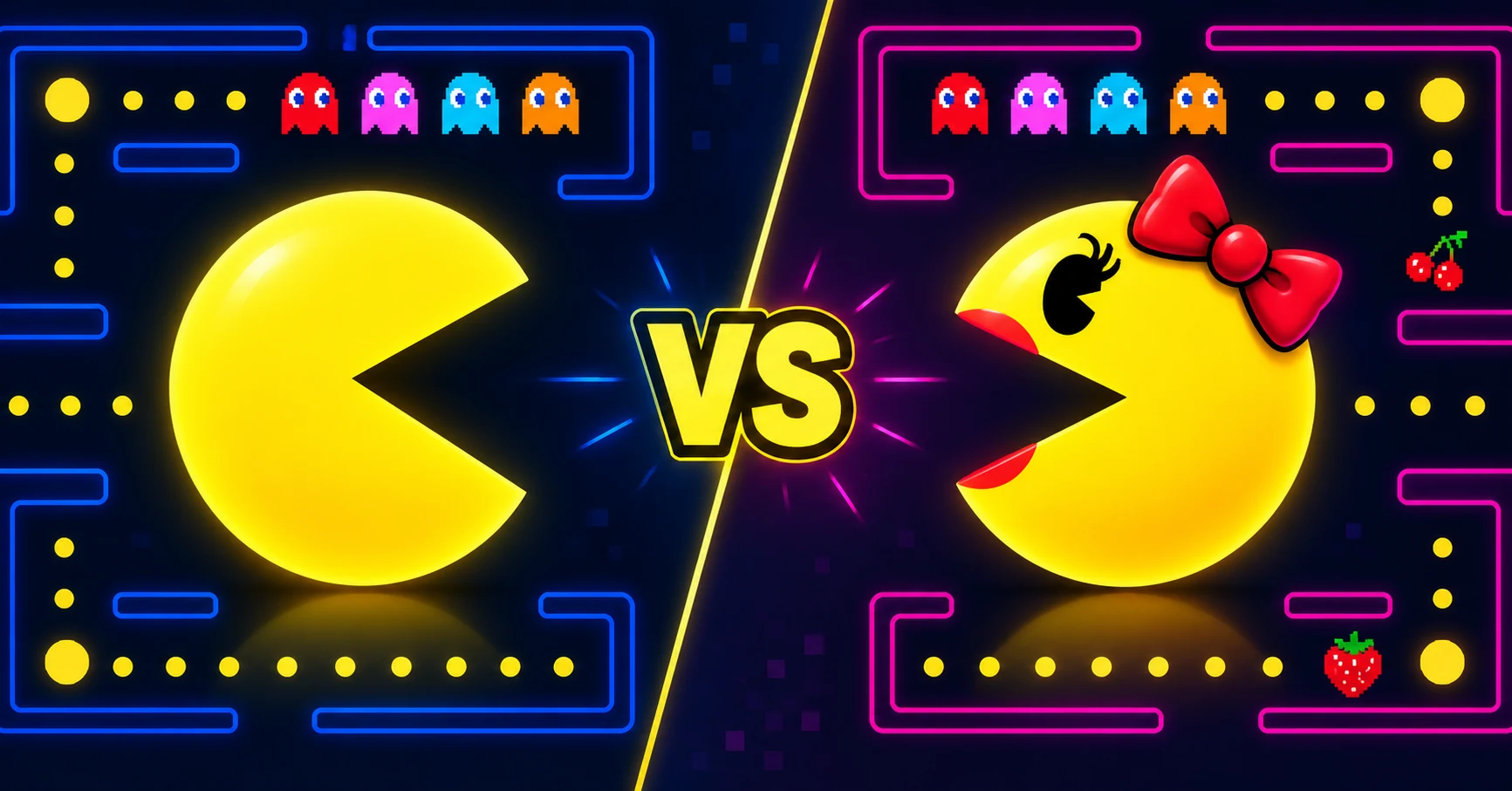
Ms. Pac-Man is usually described as "Pac-Man but with a female character." That undersells it. Ms. Pac-Man was widely considered a better game than the original when it launched in 1982 — and by many measures, it still is. Here's what actually changed between the two.
The short version
Ms. Pac-Man kept Pac-Man's core mechanic — eat dots, avoid ghosts, use power pellets — and improved almost everything else:
- 4 different mazes that rotate every few levels, instead of 1 maze forever
- Smarter (less predictable) ghost AI, breaking the pattern exploits players had memorized
- Moving fruit that bounces around the maze instead of sitting in one spot
- Faster game speed, especially from level 3 onwards
- Cutscenes between levels, showing the "romance" storyline
The result: a game that feels similar to Pac-Man for 30 seconds and quite different after 5 minutes.
The origin story
Ms. Pac-Man wasn't actually made by Namco (the studio behind Pac-Man). It was a fan-made modification called "Crazy Otto" developed by a small US company called General Computer Corporation. GCC created it as an unauthorized add-on kit that arcade owners could install in existing Pac-Man cabinets.
Midway (who distributed Pac-Man in North America) noticed how good it was, licensed it from GCC, added the Ms. Pac-Man character and cutscenes, and released it officially in January 1982. Namco itself didn't officially acknowledge Ms. Pac-Man as canon until years later.
This unusual history is why Ms. Pac-Man feels a little different in tone from every other official Pac-Man sequel — she wasn't Namco's design.
The four mazes
Pac-Man had one maze that repeated 255 times. Ms. Pac-Man rotates through four:
| Maze | Levels | Distinguishing feature |
|---|---|---|
| Maze 1 (pink) | 1-2 | Two tunnels, symmetric layout |
| Maze 2 (light blue) | 3-5 | Two tunnels at different heights |
| Maze 3 (brown) | 6-9 | One tunnel, complex central chamber |
| Maze 4 (dark blue) | 10-13 | Two tunnels, most open layout |
After level 13, the mazes cycle again. This variety was revolutionary — it meant players couldn't just memorize one perfect pattern.
The randomized ghost AI
The original Pac-Man's ghosts follow deterministic algorithms. Same inputs, same outputs — every time. Skilled players exploited this to memorize "patterns" that would clear a level without ever taking a risk.
Ms. Pac-Man added pseudo-randomness. The ghosts still use similar targeting logic (see our breakdown of ghost behavior) but with a random seed that changes each game. This means:
- The same movement pattern doesn't always give the same result
- Players have to react to what the ghosts actually do, not follow a script
- Runs feel different from each other, giving Ms. Pac-Man more replay value
Many hardcore Pac-Man players consider this the single most important upgrade — it turned a memorization game into an actual skill game.
The moving fruit
In original Pac-Man, the bonus fruit appears in a fixed location under the ghost house. You either detour to grab it or you don't. In Ms. Pac-Man, the fruit enters through a tunnel and bounces around the maze at Pac-Man's speed. You have to actively pursue it, which sometimes means abandoning a good dot-eating route.
Which one is harder?
Ms. Pac-Man is objectively harder because:
- The ghost randomness eliminates memorization
- Game speed increases faster
- Moving fruit forces risky detours
- The four-maze rotation gives less time to adapt to any one layout
But it's more fun for exactly those reasons. Original Pac-Man rewards memorization; Ms. Pac-Man rewards adaptability.
Which one to play first?
If you're new to Pac-Man style games:
- Start with Classic Pac — learn the fundamentals with the simpler original
- Move to Ms. Tapman after you can beat level 3-4 of Classic Pac — this is our site's version of Ms. Pac-Man
- Then explore variants from our ranked list of all 34 games
The trademark situation
Ms. Pac-Man has a complicated legal history that briefly made her semi-obscure. In 2019, AtGames (a game hardware company) discovered that Midway may never have properly licensed the character from GCC. They struck a deal with GCC directly and started producing "Ms. Pac-Man" arcade cabinets independently of Bandai Namco. Bandai Namco has since removed Ms. Pac-Man from some official products and replaced her with "Pac-Mom," a similar character they can freely use.
This is why browser recreations often call the character "Ms. Tapman" or use different names — the Ms. Pac-Man trademark is now genuinely uncertain, so developers avoid the name.
Related reading
- Every Ms. Pac-Man Game
- Who Created Pac-Man? The Toru Iwatani Story
- When Was Pac-Man Made? The 1980 Release Story
- The Four Pac-Man Ghosts
- Best Pac-Man Games Ranked
💡 Browse our full directory of our full Pac-Man collection — 34 games, no download required.