Pac-Man Arcade Games: Complete List with Free Browser Alternatives
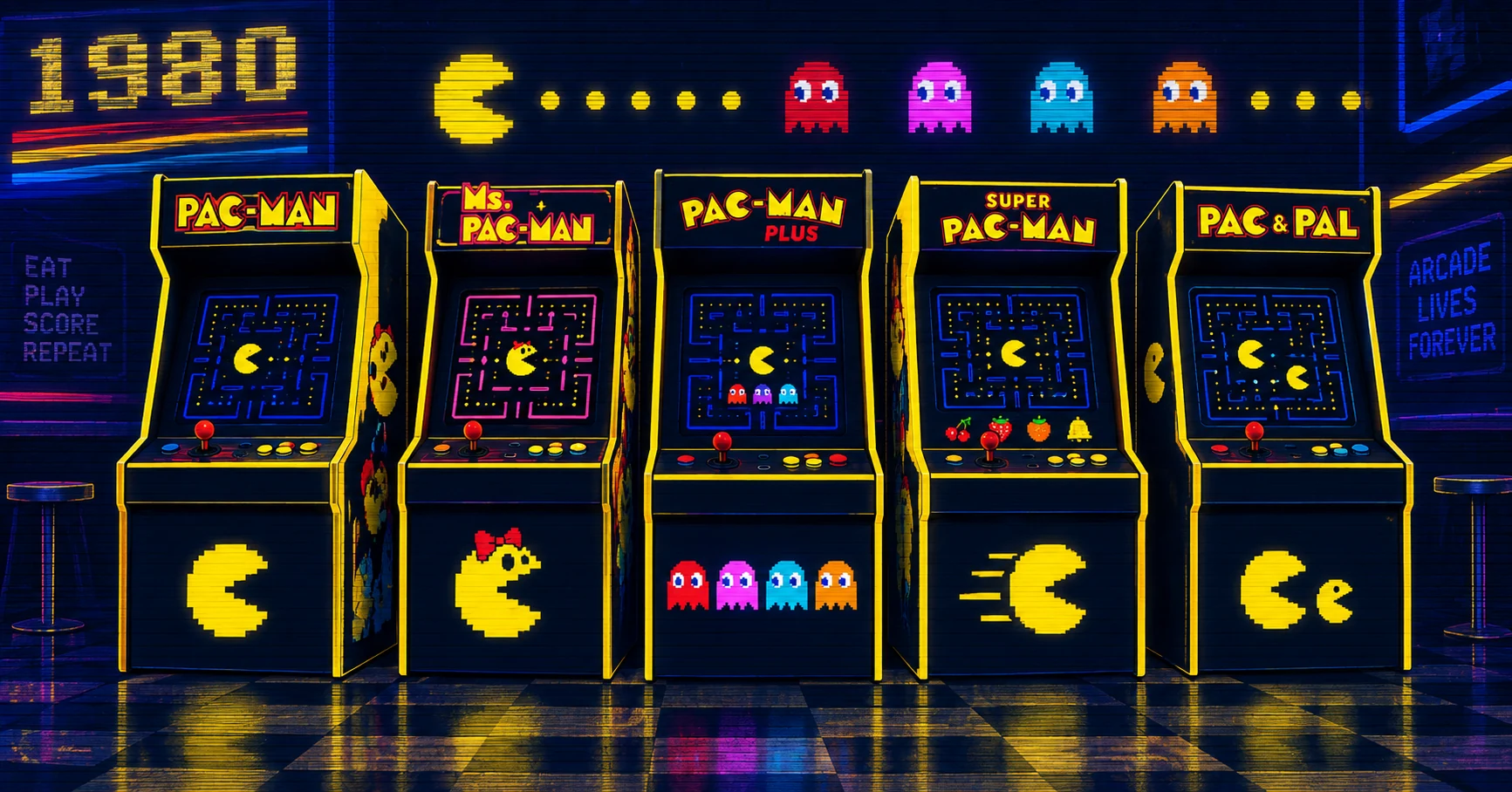
Before Pac-Man came to consoles and mobile, it lived in arcades. Between 1980 and 1990, Namco released 11 different Pac-Man arcade cabinets — each with unique gameplay, hardware, and quirks. Here's the complete list, plus free browser versions you can play today.
Looking to buy a Pac-Man arcade game rather than read about one? Home cabinets, cocktail tables, mini machines, plug-and-play consoles and the board games are covered in our Pac-Man arcade machines & board games buyer's guide.
Every Pac-Man arcade game (1980-1990)
Pac-Man (1980)
The original that started it all. Released by Namco in Japanese arcades on May 22, 1980. The cabinet ran on Namco's proprietary 8-bit hardware based on the Zilog Z80 CPU. Standard controls: 4-way joystick, no buttons.
Play the browser version: Classic Pac
Ms. Pac-Man (1982)
Originally a fan-made modification called "Crazy Otto" by General Computer Corporation. Midway licensed and released it officially. Four rotating mazes, randomized ghost AI, moving fruit. Widely considered better than the original.
Play the browser version: Ms. Tapman
Read more: Pac-Man vs. Ms. Pac-Man comparison
Super Pac-Man (1982)
Namco's attempt to move beyond the original formula. You eat keys to unlock doors, then collect fruit instead of dots. Introduced the "Super" power that made Pac-Man giant and invulnerable temporarily. Commercially mixed reception.
Pac-Man Plus (1982)
An enhanced version of the original Pac-Man cabinet with modified ghost behavior. Power pellets could randomly grant different effects (invisible ghosts, teleport, etc.) making outcomes less predictable.
Baby Pac-Man (1982)
Unique hybrid: half arcade game, half pinball machine. The arcade screen was on top, the pinball playfield below. Two lives were shared across both modes. A commercial curiosity that didn't spawn imitators.
Jr. Pac-Man (1983)
Larger maze that scrolls horizontally as Pac-Man moves. New enemies and fruit designs. Considered by some fans as a legitimate sequel; officially licensed but not developed by Namco (Bally/Midway made it).
Pac & Pal (1983)
Introduces "Miru," a green helper character who follows Pac-Man around. Some later games retconned Miru but this was her debut. Faster gameplay than the original.
Professor Pac-Man (1983)
Departure from the maze format entirely — a trivia game with Pac-Man theming. Commercial failure; very few cabinets survive today.
Pac-Land (1984)
Complete genre pivot — a side-scrolling platformer instead of a maze game. Pac-Man walks (yes, walks — he has legs in this one) through obstacle courses. Influential for the platformer genre.
Pac-Mania (1987)
First 3D Pac-Man, using an isometric perspective. Pac-Man can jump over ghosts. Multiple mazes with unique layouts. See our guide to 3D Pac-Man games.
Play the browser version: Pacmania 3
Pac-Panic (1990)
Final arcade-only Pac-Man game before the franchise moved primarily to home consoles. Falling-block puzzle mechanics; Pac-Man is one of several playable characters.
Arcade hardware evolution
The hardware in Pac-Man cabinets evolved substantially across the decade:
- 1980 Pac-Man: 3 MHz Zilog Z80, 2 KB RAM, custom video chip
- 1982 Super Pac-Man: upgraded to 6 MHz Z80, 16 KB RAM
- 1984 Pac-Land: multi-processor system, sprite-based scrolling
- 1987 Pac-Mania: Namco System 1 hardware with sprite scaling for isometric 3D
Why classic arcade Pac-Man still feels different from browser recreations
Even the best browser versions can't perfectly capture the arcade experience because:
- Latency — arcade CRT displays had near-zero input lag; modern browsers add 40-80ms
- CRT visuals — the scan lines and phosphor glow of arcade monitors are aesthetic that emulators can only approximate
- Physical controls — the specific joystick feel of arcade cabinets is impossible to replicate with keyboard or touch
- Sound — arcade cabinets had large speakers with distinctive audio quality
That said, modern browser versions are extremely close. If you want the arcade experience without the arcade, Classic Pac gets you 95% of the way there.
Where to play arcade Pac-Man games today
Free browser versions (our site)
- Classic Pac — for the 1980 original
- Ms. Tapman — for the 1982 Ms. Pac-Man
- Pacmania 3 — for the 1987 3D Pac-Mania
Paid legitimate options
- Pac-Man Museum+ ($20 on Steam, PS4/5, Switch, Xbox) — 14 official arcade titles
- Arcade1Up cabinets ($300-500) — home-scale arcade cabinet reproductions
- Bandai Namco Museum compilations for older consoles
Real arcade cabinets
If you want the genuine experience, look for retro arcade bars, barcade venues, or the "Pinball Museum"-style locations that stock 1980s arcade machines. Original Pac-Man cabinets in working condition sell for $2,000-4,000 depending on cosmetic condition.
Related reading
- Old Pac-Man Games, 1980–1999
- Pac-Man History Timeline
- Who Created Pac-Man?
- All Pac-Man Games in Chronological Order
- 3D Pac-Man Games
💡 Browse our full directory of free Pac-Man games online — 34 games, no download required.